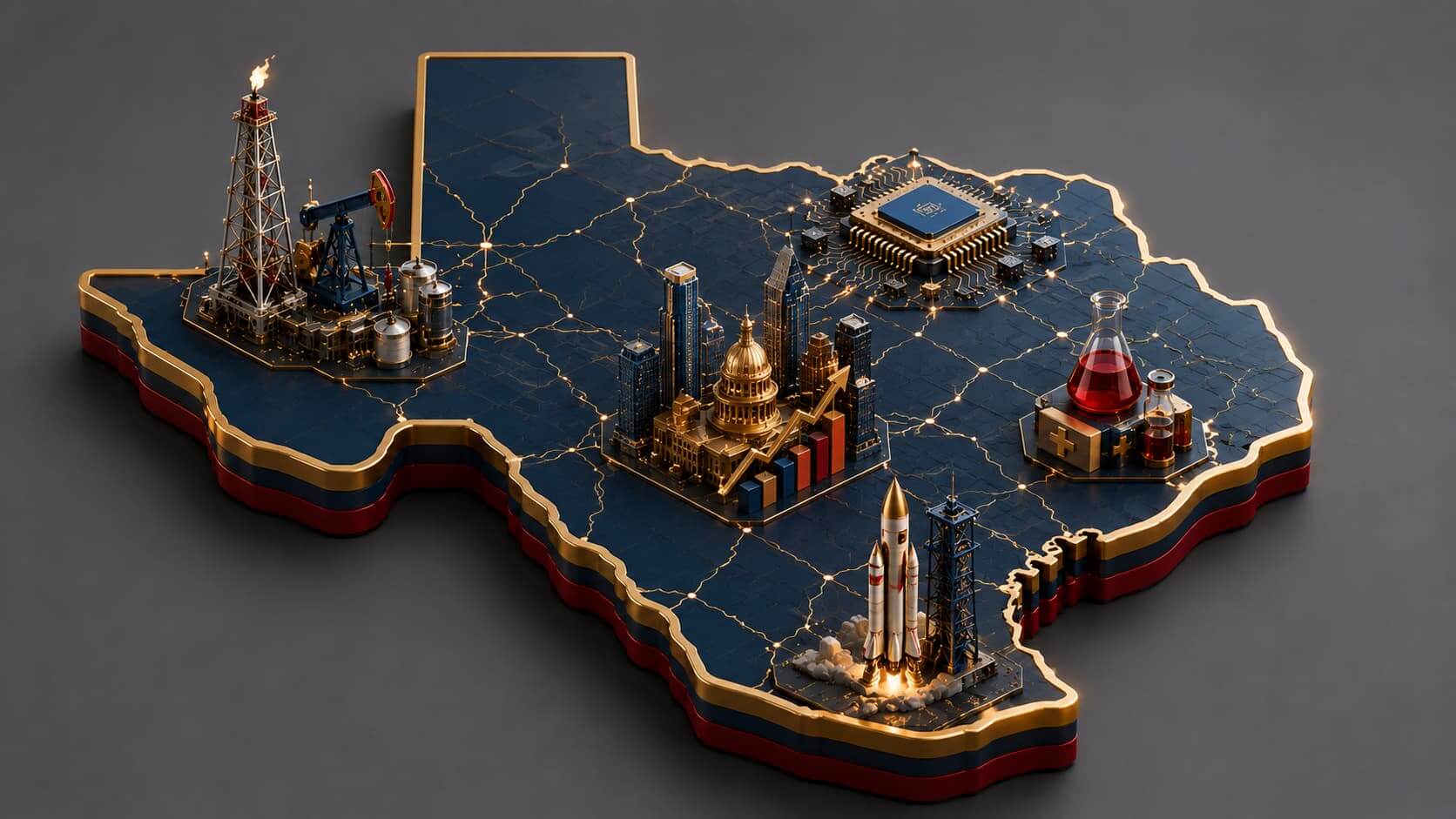
The State of What’s Next: 5 Sectors Where Texas Is Leading
For executives evaluating relocation, expansion, or U.S. market entry, Texas offers scale across multiple high-growth sectors at once. From energy and semiconductors to aerospace, life sciences, and financial services, many of the top industries in Texas are shaping what comes next for the national, and even global, economy.
Here are five Texas business sectors where the Lone Star State is clearly leading.
1. Energy
With record renewable generation, massive oil and gas output, and new investment in advanced nuclear, the Texas energy sector gives energy-intensive companies a rare mix of supply, infrastructure, and market diversity.
The state accounts for 43% of U.S. crude oil production and 28% of U.S. natural gas gross withdrawals, according to the U.S. Energy Information Administration.
It also offers, per ERCOT:
- 39,968 MW of installed wind capacity as of July 2025
- 35,123 MW of utility-scale installed solar capacity as of October 2025
- 14,137 MW of installed battery storage as of July 2025
As demand for electricity continues to rise from advanced manufacturing, data centers, artificial intelligence, and industrial development, Texas’ energy portfolio provides companies access to one of the nation’s most dynamic energy markets.
2. Advanced Manufacturing
Texas advanced manufacturing is increasingly becoming a center of gravity for semiconductors and other high-value industries that depend on sophisticated supply chains, skilled talent, and long-term investment.
Texas Instruments’ Sherman site is a prime example, representing a potential $40 billion investment across up to four connected fabs, with the first fab now in production.
The investment reflects a broader trend. As federal initiatives such as the CHIPS and Science Act support domestic semiconductor production, Texas continues to attract manufacturing projects that strengthen supplier networks, expand workforce opportunities, and increase U.S. production capacity.
For companies evaluating growth opportunities, this momentum extends beyond chip fabrication. Semiconductor investments create demand for suppliers, equipment manufacturers, logistics providers, construction firms, and technology companies, contributing to a broader advanced manufacturing ecosystem.
3. Aerospace
The Texas aerospace and aviation industry spans commercial space, defense aviation, aircraft systems, and next-generation manufacturing.
SpaceX’s Starbase operations in South Texas have created more than 3,400 full-time jobs, according to Cameron County records. Meanwhile, Lockheed Martin continues F-35 final assembly operations in Fort Worth, and Bell Textron is expanding its footprint with a Future Long Range Assault Aircraft facility.
Together, these investments position Texas at the intersection of commercial space innovation, national defense, advanced engineering, and aerospace manufacturing.
4. Life Sciences
The Texas biotech and life sciences industry extends across research, clinical care, biotech, and commercialization.
The Texas Medical Center is the world’s largest medical complex, with:
- 61 member institutions
- 21 hospitals
- 4 medical schools
- 106,000 employees
- 160,000 daily visitors
MD Anderson also launched a $2.5 billion philanthropic campaign in November 2025, with more than $1.9 billion raised during its silent phase to support cancer research, care, and innovation, further strengthening Texas’ research base and its life sciences pipeline.
5. Financial Services
Texas is increasingly emerging as a major financial center. In September 2025, the Texas Stock Exchange received SEC approval to operate as a national securities exchange, creating a new platform for public markets competition. For finance leaders evaluating opportunities around the exchange, what CFOs should know about TXSE extends beyond the launch itself to broader implications for capital access, competition, and market participation.
At the same time, Goldman Sachs is building a major Dallas campus with capacity for more than 5,000 employees, while Texas’ growing fintech ecosystem continues to connect finance with software, payments, artificial intelligence, and digital infrastructure.
For financial institutions, fintech companies, and capital markets participants, these developments reflect a broader shift in how and where financial services firms are investing and growing.
What These Five Sectors Mean for Companies Considering Texas
The most important takeaway is that these industries are not growing in isolation.
Energy supports industrial expansion. Semiconductors strengthen manufacturing and defense supply chains. Aerospace drives engineering and advanced production capabilities. Life sciences contribute research and innovation. Financial services provide access to capital, investment, and business services.
Together, these industries connect to the expanding Texas information and computer tech ecosystem, creating a broader platform for companies that need suppliers, infrastructure, talent, innovation, and market access in one place.
Texas’s advantage is not any single sector. It is the combination of industry depth, geographic scale, and Texas economic strength that allows companies to grow alongside some of the nation’s most dynamic business ecosystems.
The Texas Economic Development Corporation (TxEDC) supports the Office of the Governor’s Texas Economic Development and Tourism Office in marketing Texas as the number one place to do business.
Frequently Asked Questions
What are the fastest-growing industries in Texas?
Energy, advanced manufacturing, aerospace, life sciences, and financial services are among the industries attracting significant investment and helping drive economic growth across Texas.
Why is Texas a leader in advanced manufacturing?
Texas continues to attract major semiconductor and industrial investments thanks to its infrastructure, workforce, business climate, and growing supplier networks. Projects such as Texas Instruments’ Sherman campus highlight the state’s expanding role in U.S. manufacturing.
What makes Texas attractive for aerospace companies?
Texas offers a combination of aerospace manufacturing, defense capabilities, commercial space operations, research institutions, and skilled talent that supports companies across the aerospace value chain.
How large is the Texas life sciences industry?
Texas is home to one of the nation’s largest life sciences ecosystems, anchored by globally recognized institutions such as the Texas Medical Center and MD Anderson Cancer Center.
Why are financial services companies expanding in Texas?
Texas offers access to talent, capital, growing financial infrastructure, and a rapidly expanding business ecosystem. Recent developments such as the Texas Stock Exchange further reinforce the state’s position in financial services.
How do Texas industries support business growth?
Texas’ leading industries create interconnected ecosystems that provide companies with access to suppliers, customers, talent, infrastructure, research institutions, and investment opportunities.